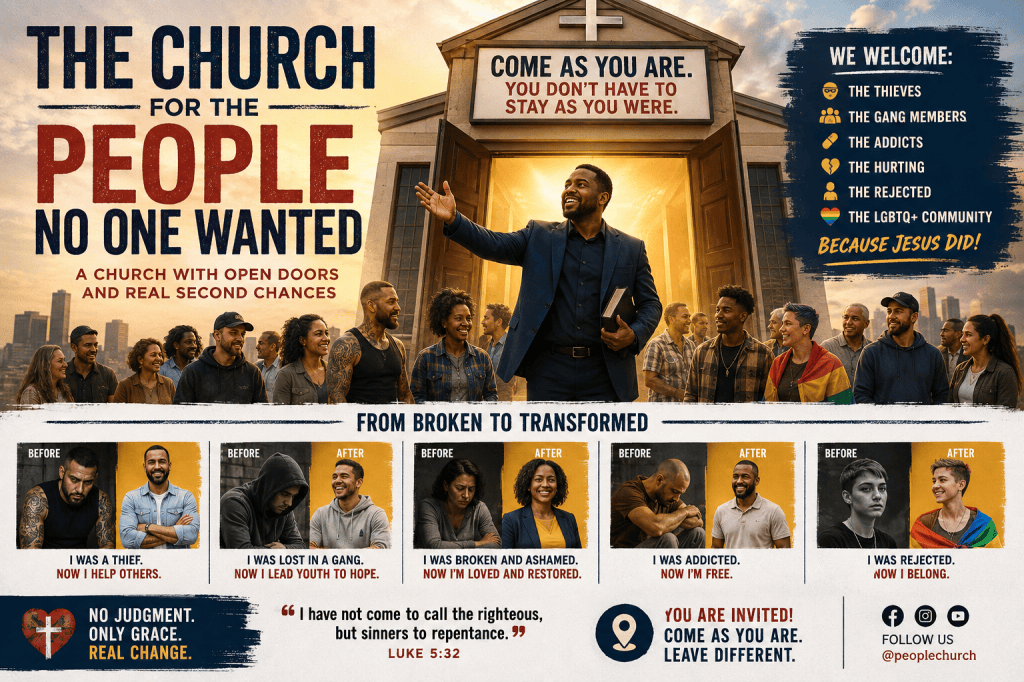
The Church for the People No One Wanted
There was a pastor named Pastor Taylor. For many years, he had been invited to preach at different churches. He was a man who loved God deeply, and whenever he stepped up to the pulpit, the church was often filled with people.
But throughout all those years, something kept troubling him.
Every Sunday, he saw churches filled with well-dressed people. Men in nice suits, women in beautiful dresses, families arriving with Bibles under their arms. Everyone seemed to know exactly how to behave when they entered the house of God.
But Pastor Taylor kept asking himself one question:
“Where are the people we are always preaching about changing?”
Where were the thieves?
Where were the gang members?
Where were the violent people?
Where were those struggling with drugs or alcohol?
Where were the sex workers?
Where were the gay people?
Where were all the people society—and many churches—had already labeled as “bad people”?
Pastor Taylor noticed something that made him think deeply: these people were often the subject of sermons, yet they were almost never sitting in the pews to hear those sermons.
One day, after preaching, he spoke with several other pastors.
He told them:
“We are always asking these people to change. But how are they supposed to come closer to God if they feel that our doors are closed to them?”
One of the pastors replied:
“Taylor, anyone can come to church.”
Taylor shook his head.
“Yes, we say they can come. But do they feel like they can come?”
The room became silent.
That was the day Pastor Taylor made a decision that would change his life.
He was going to open his own church.
But he did not want to create an ordinary church.
He announced:
“This church will be especially open to the people others do not want to see in church.”
The news spread quickly.
Many Christians were angry.
Some said Pastor Taylor had lost his mind.
Others accused him of encouraging sinful behavior.
But he always gave them the same answer:
“Accepting someone does not mean agreeing with everything they do. If a person has to become clean before entering the church, then why would they need the church?”
He placed a large sign in front of the building he had rented:
COME AS YOU ARE.
The First Sunday
The first Sunday finally arrived.
Pastor Taylor did not know if anyone would show up.
He had placed about one hundred chairs in the room.
At 8:50, only six people were there.
By 9:00, there were twelve.
But a few minutes later, the door began opening again and again.
A young man who had recently been released from prison walked in.
A woman who had spent years selling her body entered and sat in the last row.
Two men who had been involved in gangs came in together.
A gay man who had avoided churches for years quietly walked inside and sat close to the door, as if he were ready to leave the moment someone humiliated him.
Some people were well dressed.
Others came in torn pants.
Some had tattoos covering their arms.
Others entered with their heads down because they were ashamed.
Pastor Taylor stepped up to the pulpit.
Everyone waited to hear his first sermon.
He looked around the room for a few seconds.
Then he said:
“Some of you believe you have to fix your lives before you can come close to God. That is why you have stayed away for so many years.”
He paused.
“But when someone is sick, they do not have to become healthy before going to the hospital.”
The room became completely silent.
“It is the same here. I am not asking you to pretend that you are perfect. I am only asking you to walk through the door. The rest of the journey will happen one step at a time.”
A woman in the last row began to cry.
And that was how the church began.
Six Months Later
Something no one had expected began to happen.
A man who used to steal cars found work as a mechanic. He even began repaying some people for the harm he had caused in the past whenever he could.
A young man who had been involved in a gang put down his weapon and began helping other young people leave the streets.
A woman who had once been a sex worker found a job, and the church helped her find a small apartment.
Some people stopped using drugs.
Some reconciled with their families.
Others were still struggling with their problems, but at least they were no longer struggling alone.
Change did not happen overnight.
Some fell and got back up.
Some disappeared for several weeks and eventually returned.
But Pastor Taylor never allowed the open door to become a wall.
One Year Later
A year after the church opened, so many people were attending that they had to place extra chairs outside.
One Sunday, Pastor Taylor decided not to preach.
Instead, he placed a microphone in the middle of the church and said:
“Today, you are going to speak.”
One after another, people stood up and told their stories.
Finally, a man named Sander took the microphone.
There were tears in his eyes.
He said:
“I spent almost twenty years without entering a church.”
Pastor Taylor asked him:
“Why?”
Sander replied:
“Because every time I heard Christians talking about people like me, I felt as though they had already condemned me before they even knew me.”
He looked around the room.
“The first day I walked into this church, I thought someone would throw me out. But nobody asked me what kind of person I was before giving me a chair.”
His voice began to break.
“They gave me the chair first.”
The entire church became silent.
Sander continued:
“And it was sitting in that chair that I began to change.”
Even some of the pastors who had once criticized Pastor Samuel were present that day.
One of them sat in the front row with tears in his eyes.
After the service, he approached Taylor.
He said:
“I thought you were going to ruin the church when you opened the doors to all these people.”
Taylor smiled.
The pastor continued:
“But today I understand something. Maybe we spent too much time trying to protect the church from the very people Jesus would have gone looking for.”
Taylor said nothing.
He simply looked around the room.
He saw a former thief arranging chairs.
He saw a former gang member helping an elderly person leave the church.
He saw people from completely different walks of life talking, laughing, praying, and eating together.
On the wall behind the pulpit, the same words from the church’s first day were still written:
COME AS YOU ARE.
But underneath them, another sentence had been added:
YOU DON’T HAVE TO STAY AS YOU WERE.
Pastor Taylor looked at those two sentences and smiled.
He finally understood the mission of his church.
He had not built a church for perfect people.
He had built a door for people who believed there were no doors left open for them.
And that open door gave many of them their first real chance to begin a new life.
THE END
Written by: Roostacot Previl
 KB STORIES
Leave a comment